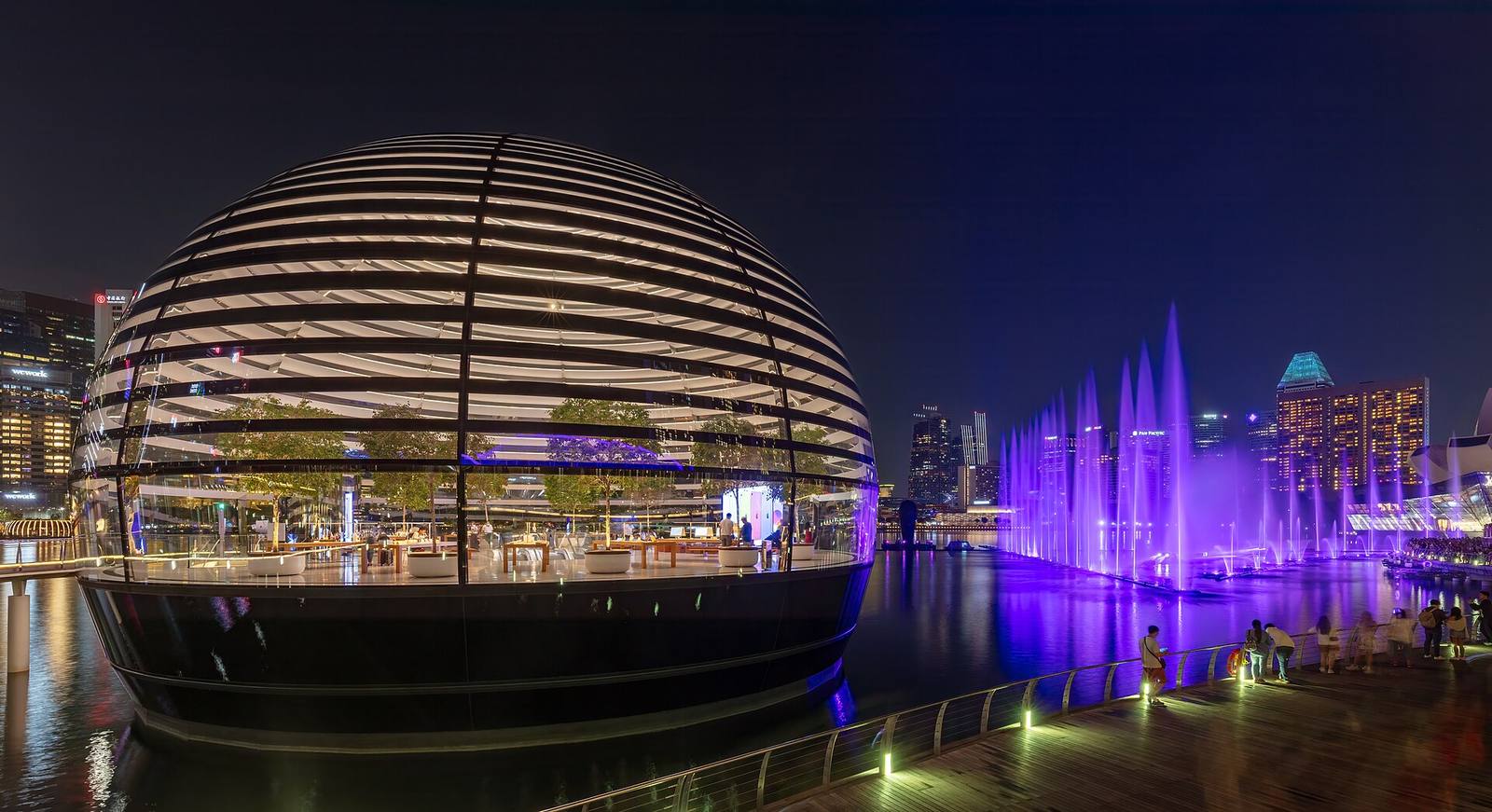
Singapore S-REITs (Industrial & Retail)
Composite-board score: 8.1 · Where it is strong: Net cash flow, Stability & rule of law · methodology
Proposed rank #7. What puts Singapore on the board is not physical property but listed REITs: industrial and retail S-REIT distribution yields of about 5.5–6.4% (SGX-published data, end-2025 to Q1 2026), where distributions are cash in hand after all trust-level costs and interest — directly comparable with this board's net-return basis. The costs are equally plain: no asset ownership or control, unit prices that move with rates and market sentiment, and distributions that are not total return. For a Singapore-based individual investor, this is the lowest-friction, lowest-ticket, most hands-off cash-flow tool on the whole board.
In short: four lines first
Low (buy on the secondary market, from a few hundred SGD, no minimum ticket)
5.5–6.4%(Net return)
High (listed units; no tenants or property management)
Distributions are not total return: the distribution yield is a cash measure, while unit prices can fall more than 20% in a rate-hiking cycle; from 2022 to 2024 many S-REITs cut DPU as financing costs rose. Looking at the distribution yield alone systematically understates this asset's volatility.
The numbers that matter
Why we think it makes money
The yield is a post-cost, in-hand measure, and the evidence tier is the highest on this board. SGX Research's S-REITs & Property Trusts Chartbook 4Q 2025 shows large industrial REIT distribution yields: CapitaLand Ascendas 5.3%, Mapletree Logistics 5.6%, Mapletree Industrial 6.2% (31 Dec 2025); the sector average distribution yield is 6.4% (31 Mar 2026). DPU is paid after property costs, trust fees and borrowing interest are deducted — there is no "gross 5–8%, netting down to 3%" basis gap of the kind physical property has.
Friction is lowest for Singapore-based investors. Compare rank 9 on the overseas cash-flow board, US self-storage (cap rates 5.8–5.9%): a Singaporean taking part must clear cross-border operations, withholding tax, estate tax and currency — four gates. An S-REIT is SGD-denominated, locally listed, held via CDP, with tax-exempt distributions for individuals, exit available any trading day, and a ticket starting at a few hundred SGD — a different order of magnitude from any physical asset on this board.
Scale and diversification are data-backed. At end-2025 Singapore had 41 listed REITs and business trusts with a combined market capitalisation of about S$104 billion, roughly a tenth of SGX's total; both the industrial and retail sub-sectors offer several large trusts, so cash flow need not be bet on a single asset or a single tenant.
How to actually get in
- Fix the basis: screen on two numbers only — distribution yield and the balance sheet (leverage, interest coverage). Do not chase unit-price stories, and do not treat distributions as total return.
- Pick the sub-sector: industrial/logistics and retail are this page's scope. For industrial, look at large diversified portfolios such as CapitaLand Ascendas, Mapletree Industrial and Mapletree Logistics (distribution yields 5.3–6.2%, at 31 Dec 2025); for retail, Frasers Centrepoint and CapitaLand Integrated Commercial (about 4.8–5.8%). The 7–8% high-yield names (ESR-REIT, Daiwa House Logistics and the like) carry higher leverage and asset risk and are outside this page's low-friction basis.
- Buy: purchase on SGX through a local broker, with units registered at CDP; distributions arrive in cash quarterly or semi-annually. This site only states that the channel exists — it does not recommend or sell any specific product; tickers and buy/sell decisions are yours to verify.
- Review while holding: each results season, check three things — whether DPU is falling consecutively, whether leverage is approaching 45%, and whether occupancy and rental reversions have turned negative. If a flip condition in this page's risk section triggers, reduce or exit.
- Position versus physical assets: an S-REIT is a cash-flow base tool; it does not replace the control and appreciation optionality of physical assets. When combining both in one portfolio, size by cash-flow target, not by name recognition.
What it costs, what it earns
Entry amount: Low (buy on the secondary market, from a few hundred SGD, no minimum ticket)
How much work for you: High (listed units; no tenants or property management)
- Trust-level fees: manager fees, trustee fees, property operating costs and borrowing interest are deducted from trust income before distribution; holders pay nothing further. This page's yields are the post-deduction distribution basis — no gross-to-net conversion is needed.
- Investor-level transaction costs: buying and selling costs only brokerage commissions (roughly 0.03–0.28% depending on the broker — check the fee schedule) and the bid-ask spread; holding via CDP carries no annual custody fee, and secondary-market trades attract no additional stamp duty.
- Tax: distributions received by individual investors in S-REITs are tax-exempt (IRAS arrangements for individual investors); capital gains on selling units are not taxed in Singapore (for individuals, non-trading in nature). Holding through a company or partnership structure is a different basis and must be confirmed case by case.
- Opportunity-cost note: distributions come back as cash and are not auto-reinvested; spending distributions versus compounding them makes a large long-term difference to total return. This page speaks only to the cash-flow basis, not to reinvestment assumptions.
Basis: this site uses full-cost net returns only — income minus vacancy, management, maintenance, taxes and insurance, then financing interest, with entry costs in the denominator. See the methodology。
Identity & tax
Status (residency / citizenship)
This asset does not count toward the channel This asset leads to no status
Threshold: S$10,000,000 起(新设/扩充本地企业);基金路线 S$25,000,000
在 SGX 买 S-REIT 不给任何身份:新加坡没有被动投资者居留,买房同样不是 GIP 通道。真正的投资移民只有 GIP——S$1,000 万投入本地企业(直接给 PR)、S$2,500 万入 GIP 精选基金,或单一家办路线(S-REIT 等 SGX 上市股票只是家办路线里「指定部署类别」之一,份额本身不产生资格)。新加坡卖的是规则稳定,不是签证;入籍还要求放弃原国籍(不承认双重国籍)。
Source: 新加坡经济发展局(EDB)《GIP 说明书》(2025-05-05 更新);ICA
Tax (investor level)
属地税制 + 无资本利得税 + 无股息预提——S-REIT 分派在新加坡层面的摩擦是全榜最低的一类。
- 属地税制:个人的境外来源收入即便汇入新加坡也一般免税(第 10L 条针对的是低实质实体,不是个人)。
- 资本利得:不征(属收入性质的交易利得除外,投资者/交易者界线逐案判断)。
- 股息预提:无。S-REIT 分派对非居民「非个人」投资者预提 10%(优惠延续至 2030-12-31);个人投资者的适用口径与注意事项见本页「未核实清单」。
- 对照线:非居民个人直接持有新加坡房产收租,净租金按 24% 征税——这正是本页选上市通道而非实物的税务理由之一。
Double-tax treaties: 新加坡有 90 多个全面税收协定,与中国、印度均已生效;与美国没有全面所得税协定(美国来源股息对新加坡居民仍是 30% 预提)。新加坡是 CRS 参与方。
Source: 新加坡税务局(IRAS);2025 年财政预算案
This section is general information only — not immigration or tax advice. Program rules change frequently; before acting, rely on the official texts and a licensed adviser.
Risks: what could go wrong
What we have not verified yet
The following key figures have not yet been verified; the reason is noted for each item.
- This page's yields are point-in-time market data (distribution yields at 31 Dec 2025 and 31 Mar 2026) that move with unit prices daily; they are not a locked return for any period. On intake, re-check against the latest SGX Chartbook.
- Forward DPU guidance, refinancing schedules and interest-rate hedging ratios were not verified trust by trust; the 8%-band high-yield names received no asset-level due diligence — this page only marks them as a higher-risk band.
- No citable institutional series was found comparing long-run (20-year) total returns of S-REITs against direct industrial property holdings — unverified; this page's verdict rests on the cash-flow basis only.
- The tax-exempt treatment of distributions for individual investors is stated per current IRAS arrangements; holding through non-individual structures, or rule changes, requires re-confirmation.
FAQ
- Is the 5.5–6.4% distribution yield net? Is there anything more to deduct?
- Yes, it is an in-hand figure. Distributions (DPU) are cash paid to holders after the trust has deducted property operating costs, manager and trustee fees and borrowing interest; at investor level only the one-off brokerage commission remains. So this page's 5.5–6.4% compares directly with the net returns of other opportunities on this board, with no second round of deductions — exactly what separates it from portal figures like "gross yields of 5–8%".
- How does it differ from buying an industrial unit myself and collecting rent?
- Three differences. First, control: with a physical unit you choose tenants, negotiate renewals and decide whether to sell; a REIT unit carries only distribution and voting rights. Second, net return: a strata industrial unit, after vacancy, property tax and management fees are deducted item by item, nets about 3–4.5% (see the workings on this site's Singapore country page) — below the REIT distribution range. Third, ticket and exit: a physical unit starts around S$500k and selling means finding a buyer, with seller's stamp duty on industrial property sold within three years; a REIT starts at a few hundred SGD and can be sold any trading day, but its price moves with the market.
- What tax does an individual pay on S-REITs?
- Individual investors holding S-REIT units directly receive distributions tax-free, and capital gains on selling units are not taxed for individuals where non-trading in nature. Buying involves no property stamp duty (it is not a property purchase and does not use any ABSD quota). Holding through a company or partnership, or trading frequently, changes the tax basis — confirm with a tax adviser.
- What is the minimum amount to start?
- There is no property-style ticket. SGX trades in lots, usually 100 units per lot, and one lot of a mainstream industrial REIT is in the few-hundred-SGD range; the actual minimum outlay is set by your brokerage account rules. This site does not recommend leveraging a REIT position: the spread between distribution yield and financing rates is thin, and price volatility arrives before distribution changes do.
- Will distributions stay this high?
- Not necessarily. Distributions come from current distributable income; when financing costs rise or occupancy falls, managers cut DPU — many S-REITs did exactly that from 2022 to 2024. When picking names, look at leverage and interest coverage before yield: the sector average distribution yield of 6.4% (31 Mar 2026) includes high-yield, high-risk names; the lower bound of this page's 5.5–6.4% range corresponds to large diversified trusts and the upper bound to the sector average — the two ends are not the same risk.
Related opportunities
Get the free one-page brief
Get the one-page brief / subscribe for updates
Leave a contact and this page will immediately show a time-limited download link for the brief (valid 24 hours). This site only sends information — it will never pitch you a specific project or pass your contact to any project party.
Received — thank you.
Your brief download link: Download the one-page brief (PDF/HTML) (valid for 24 hours; submit again after it expires).
Updates are sent only after the monthly briefing launches, and every email carries an unsubscribe link. To have your contact details deleted, contact us as described in the Privacy Policy.